Colorbond vs Tile Roof in Adelaide: Which Is Right?
Colorbond vs tile roof in Adelaide compared on cost, weight, lifespan, summer heat and storm performance. A neutral 2026 guide for SA homeowners.
Last updated
Choosing between a Colorbond steel roof and a concrete or terracotta tile roof is one of the bigger decisions an Adelaide homeowner makes, and the right answer depends on the house, the budget and the local conditions. Both materials are common across the metro area, from heritage homes in Norwood to newer builds in the northern suburbs. This guide compares them on the factors that actually move the decision, with every figure traced to a source.
Adelaide's climate sets the brief. Hot, dry summers, occasional heavy storms and the odd hailstorm all put different demands on a roof, and the two materials handle those demands in different ways.
Cost per square metre
In the Adelaide market, Colorbond steel roofing runs roughly $50 to $100 per square metre installed, while concrete and terracotta tiles sit around $80 to $120 per square metre, according to a local Roof & Render comparison. National 2026 figures are broadly similar, with concrete tile supply and install at $70 to $100 per square metre and terracotta at $100 to $160 per square metre per Roofing Today.
Across a full roof the gap can be meaningful. A 150 to 200 square metre roof typically lands between $8,000 and $18,000 in Colorbond, against $12,000 to $28,000 for tiles, based on the same Roofing Today data.
Material prices are not static either. Colorbond pricing rose around 4 to 6 percent from 2025 to 2026 on the back of raw material and manufacturing costs, per What's The Damage.
It is worth separating the upfront quote from the long-run cost. The lower Colorbond install price looks better on day one, while a premium terracotta roof can spread its higher cost over a longer working life. The right comparison is total cost across the years you plan to stay in the home, not the headline number on the quote.
Weight and structure
This is where the two materials diverge most. Tiles weigh roughly 47 to 52 kilograms per square metre, while Colorbond steel sits at about 5 to 9 kilograms per square metre, which makes the steel option close to 90 percent lighter (Roof & Render).
The practical effect is structural. A heavier tile roof needs stronger framing to carry the load, which adds to the cost on a new build and matters on a re-roof if you are switching from tile to steel. A lighter roof can simplify the supporting timber or steel, though any change of material should be checked against the home's existing structure by a qualified roofer.
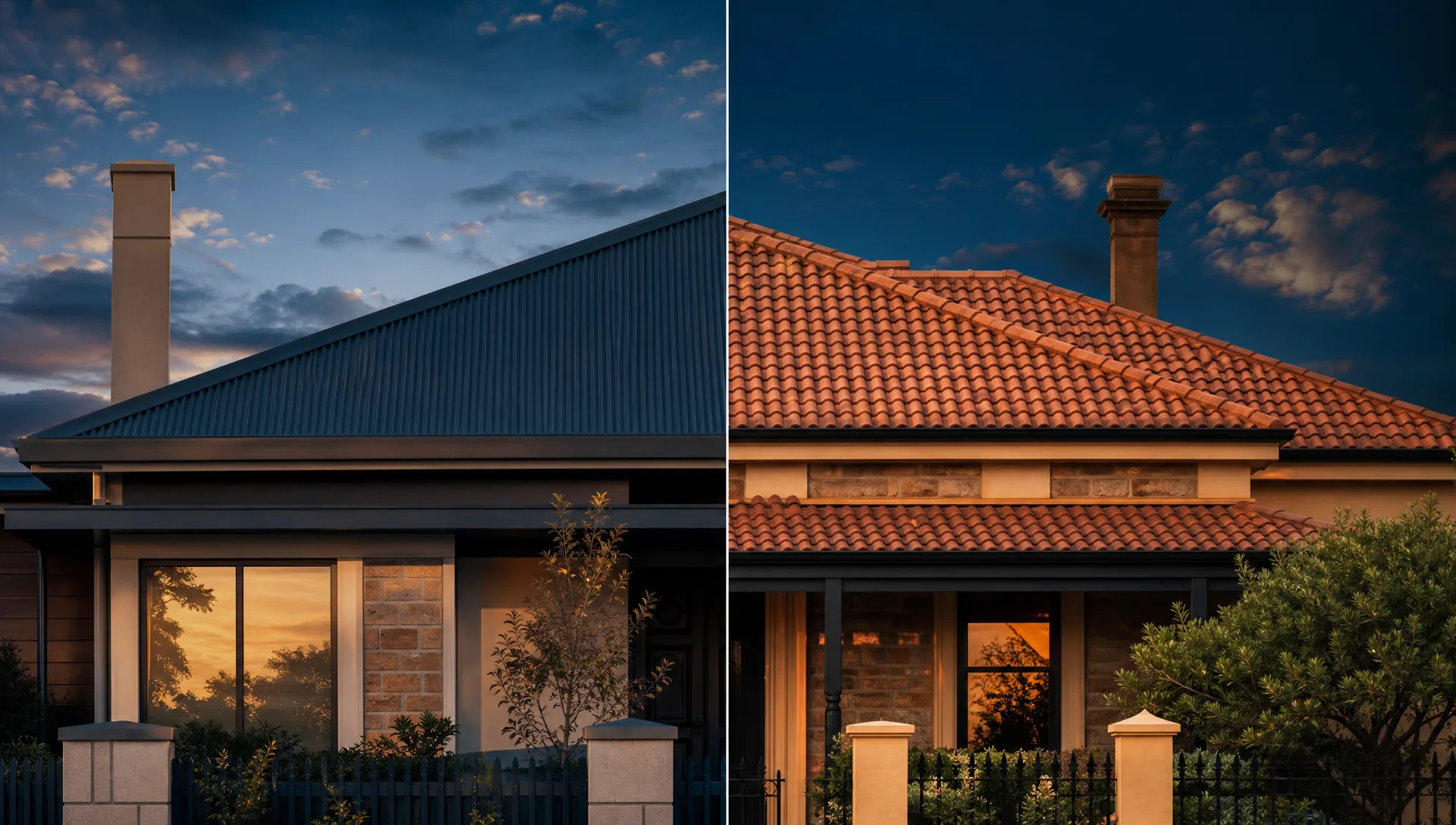
Weight also shapes the look. Tiles give a roof depth and a stepped profile that many Adelaide buyers associate with established homes, whereas steel sheeting reads as flatter and more contemporary. Neither is objectively better, and the structural cost of carrying that extra tile mass is part of the trade-off.
Lifespan
Colorbond steel carries a BlueScope warranty of up to around 45 to 50 years and frequently lasts beyond that when installed and maintained correctly, per Roofing Today. Tile lifespan estimates vary more widely between sources.
Terracotta tiles are the long-haul option, with some sources putting their working life beyond 70 years, while concrete tiles are generally cited at 40 to 50 years (Roofing Today). The catch is that tiles only reach those numbers with upkeep, since ridge capping and mortar bedding need re-pointing every 10 to 20 years.
So the headline lifespan numbers for premium tile can exceed steel, but they assume ongoing maintenance that steel does not require to the same degree.
Heat and summer comfort
In Adelaide's summer, roof colour and reflectance matter as much as material. Colorbond's core colour range uses Thermatech solar reflectance technology, which BlueScope says reflects more of the sun's heat to help keep homes cooler, detailed on the official Colorbond steel site. Lighter colours such as Surfmist and Shale Grey can reflect a large share of solar radiation, and Thermatech can cut roof surface temperature by around 5 to 6 degrees Celsius at peak summer (Roof & Render).
Tiles behave differently. They absorb and store heat through the day, then release it slowly into the evening, which keeps a home warmer later into the night.
The gap narrows with insulation. Good quality insulation under either roof type makes the difference between the materials close to negligible for indoor comfort, per Roof & Render's insulation notes.
Storms, hail and rain noise
Adelaide storms are the other half of the climate brief. Colorbond steel is rated to withstand hailstones travelling at up to about 90 kilometres per hour, roughly the impact of a cricket ball, and its sheets resist the cracking that can let water through a tile roof, according to Roof & Render. A single cracked or dislodged tile after a storm can lead to cascading water damage if it goes unnoticed.
Rain noise is the most common worry about steel, and it is largely solved at installation. Over a ceiling with an insulation blanket, a metal roof is generally no louder than other materials, and the blanket also helps prevent condensation on the underside of the sheets, which is worth specifying in cooler pockets like the Adelaide Hills.
Tiles are naturally quieter in heavy rain because of their mass, which some homeowners prefer regardless of how the steel is insulated.
Maintenance
Colorbond is the lower-maintenance option, needing little more than periodic cleaning to clear debris and a professional check of flashings and seals every two to three years, with gutters kept clear. Tiles ask for more attention over time.
Beyond the 10 to 20 year re-pointing of ridge capping, tile roofs in Adelaide need management of moss and lichen and replacement of any cracked tiles. None of this is difficult, but it is recurring cost and effort that the steel option largely avoids.
For an owner who plans to stay in the home for decades, the maintenance picture compounds. Two or three re-pointing cycles over the life of a tile roof add real money, while a Colorbond roof of the same age has mostly needed cleaning and a periodic inspection. That difference is part of why the cheaper-per-metre tile roof does not always end up cheaper over thirty years.
Which suits an Adelaide home
For a budget-conscious owner or a modern build, Colorbond's lower install cost, light weight, reflective summer performance and minimal upkeep make it the practical default for much of metro Adelaide. The lighter load and storm resistance also suit re-roofing older houses, provided the structure is assessed first.
Tiles still have a clear place. They suit heritage and traditional homes in areas like Norwood and Burnside where the look matters for character and resale, and premium terracotta can outlast steel if the owner is willing to keep up the maintenance. The choice comes down to budget, the age and style of the house, and how much ongoing upkeep the owner wants to take on.
Looking for verified local companies? See our top picks for Best Colorbond & Metal Roofing in Adelaide (2026).